Welcome to Your Historical Compass

"The purpose of this blog is to generate discussions about historical issues. Students, enthusiasts, and friends are all welcome to join by reading and participating with comments. I hope to generate interest in history and offer help to the perplexed." Caleb Johnson

Saturday, April 14, 2012

Ireland


Cold, remote and small, Ireland is a land where history abounds, but one which history has largely forgotten. As it lies on the fringes of the European continent, Ireland must strain to even gain mention. Indeed the island has been dominated by its western neighbor for nearly a millennium. But it was not always this way.


During the fall of the Roman Empire, Ireland remained untouched by the subsequent Germanic invasions that swept the continent and ravaged what was left of Rome’s imperial glory. Some Roman citizens even fled to Ireland’s shores, but some were taken there by force. One such captive, St. Patrick, would have a profound impact on not just Irish history, but European as well. St. Patrick was the main force in the conversion of the pagan tribes to Christianity. Once Ireland was united under the Christian faith, monasteries sprang up and supplied the forum for the last remaining news medium. One of the many practices at Irish monasteries was the transcribing of texts, sacred and secular. What they did was take old Roman texts that were written on papyri and transcribe them on parchment, which is made of animal skin. Parchment, unlike papyri, does not dissolve over a long period of time. Thus, the Irish monks were responsible for preserving many ancient documents that would have been lost simply to the detritus of time.

Yet this was not Ireland’s only legacy. Well before Pope Gregory the Great sent St. Augustine to Kent to reconvert the pagan Angles and Saxons, Ireland was well on its way to completing the conversion of the tribes. When Latin and Irish (or Celtic) clerics met at the end of their missions, there was a union of the two churches. So although time seems to have passed that westward island on the edge of Europe, its relics and its people remain a testimony to the accomplishments of ages past.

Saturday, April 7, 2012

Alexandria


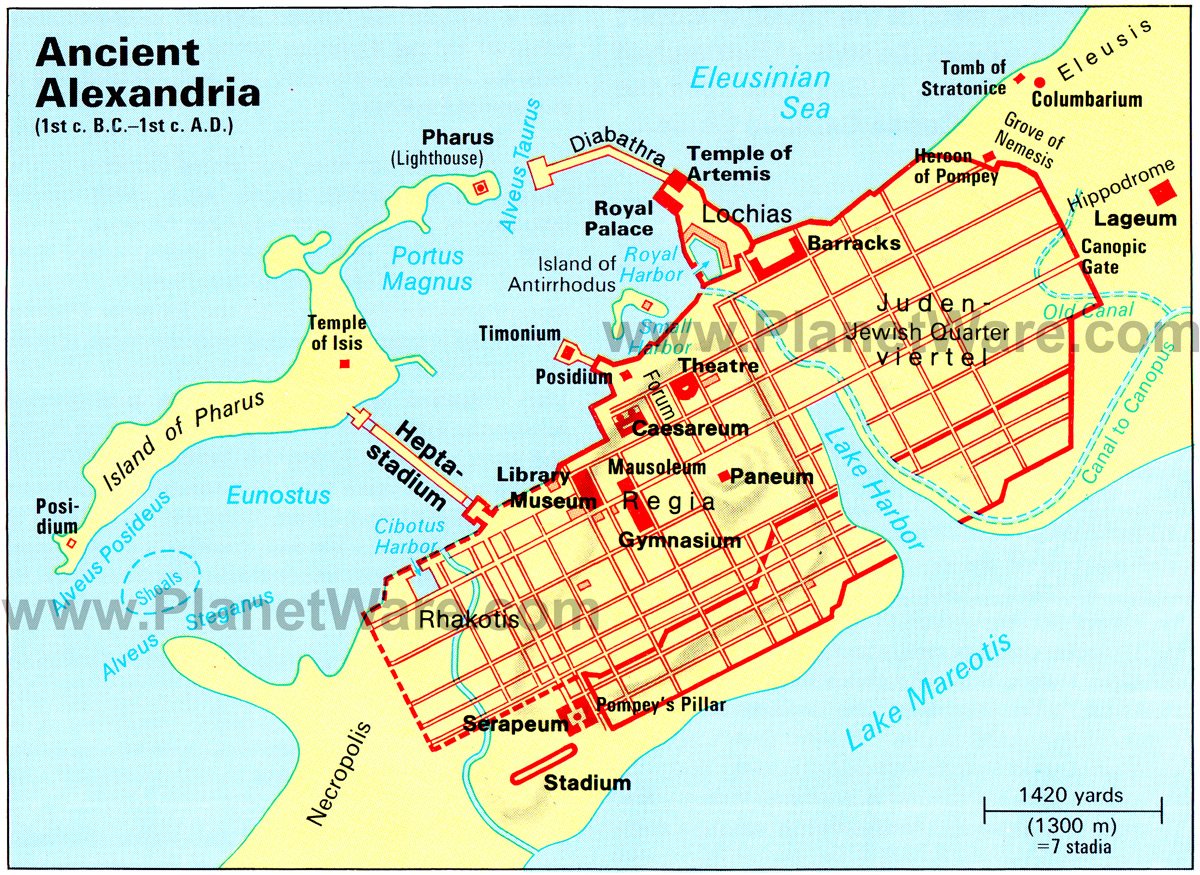
In 332 BC, Alexander the Great liberated the land of Egypt from the Persian Empire. Compelled by the flattery of the Egyptian people and perhaps a sense of his own need for immortality, Alexander decided to leave a permanent legacy in Egypt: a city at the end of the Nile Delta. This city would naturally bear his name as had the many other cities he had started along his invasion route. While the Greek surveyors lined out the streets by spreading grains of wheat, local birds flocked to eat it up. Interpreting this as a bad omen, Alexander nearly gave up the project altogether, but his skillful soothsayers convinced him that the omen was not bad but good. They interpreted to him that the way the birds were fed by the seeds, so would millions be fed by this city. 

Indeed, the prophecy proved true. Although Alexander never lived to see the city completed, Alexandria and Egypt were passed on to Alexander’s friend and general, Ptolemy. Under Ptolemy and his successors, Alexandria grew and thrived. The streets were designed to be parallel with the winds from the Northern Mediterranean so that the city could breathe in fresh air during the long summers. Built on a natural harbor, Alexandria became the leading port city of the Eastern Mediterranean and even began to rival Punic Carthage in the West. A private investor built a great lighthouse to guide the ships coming into the new Harbor of the Pharaohs. The Ptolemy dynasty sponsored a state library to house all the records from the known world. This library came to be the greatest collection of scrolls and documents to that date and wouldn’t be equaled until the founding of the Vatican Library. Such a magnificent metropolis could not but help getting into the political arena. Although the Ptolemies were able to skillfully play off the various factions that were left in the wake of Alexander’s conquests, they were forced to reckon with a new rising power in the West.

When Rome defeated Carthage in the 3rd Punic War, it was drawn into the politics of the East when it had to fight a number of defensive wars against the Greeks. When the King of Pergamum bequeathed his kingdom in Asia Minor to Rome, the Ptolemies recognized where the wind was blowing. In the 1st century BC, Ptolemy XII asked Rome to mediate the succession of his throne. These events led to further entanglement between Rome and Egypt, because Ptomely’s successor was Cleopatra VII, who married Julius Caesar and later Marc Antony. Alexandria might have become the second capital of the Mediterranean world had its chance not been squandered by the star-eyed lovers Antony and Cleopatra. Once Caesar Augustus defeated Antony and Cleopatra at the battle of Actium and incorporated Egypt into the Roman Empire, Alexandria became the second largest city next to Rome. Although it never dominated the political landscape, Alexandria continued to be a centre of learning, culture, and wealth. Ever a jewel to whomever possessed it, Alexandria passed from nation to nation but it continues to bear the name of its original founder.

Saturday, March 10, 2012

Egypt: Lost & Found


Everyone today knows of the Pyramids and Sphinx of Giza, as well as other landmarks of ancient Egypt. Hollywood has made numerous films based on Egypt, and MGM’s Luxor Palace is one of Las Vegas’ most popular attractions. Surprisingly, though, our knowledge of Egypt and particularly ancient Egypt is a fairly recent phenomenon. The beginning of what’s now called Egyptology began not with a research study, but with a minor campaign in the French Revolutionary Wars.


When Napoleon Bonaparte sailed into Alexandria and defeated the local forces of the Egyptian Mamluks at the Battle of the Pyramids, he brought with him several French architects and scholars. Spurred by the Enlightenment thirst for classical history, the French started exploring the ruins that were left behind by the pharaohs and forgotten by the sands of time. However, observe as they might, the massive structures that spotted the Nile River Valley seemed to hold more secrets than answers. Who built these structures? How did the people live? Only scraps of knowledge remained from medieval writers and some from the ancients, but to really understand the land, the new scholars would have to decipher the pictographs that decorated the walls of the temples and tombs.


This was made possible when French engineers excavated a dark stone in the village of Rosetta in 1803. The stone included three types of script: Ancient Greek, Ancient Demotic and Hieroglyphic. The task at hand was to use knowledge of the ancient Greek text to decode the Hieroglyphics and thus unlock the mysteries of the pharaohs. It took scholars twenty years to be able to competently understand Hieroglyphics but the result was a huge leap for Egyptology. Now that we are able to read Hieroglyphics, we are able to understand much of that civilization that was once described by Herodotus as “the gift of the Nile.”

Saturday, March 3, 2012

American Industrialism


Although we live in a time of suburbs, renewable energy sources and a largely service-based economy, America used to be the world’s leading manufacturer. General Motors, US Steel, Standard Oil, and the B&O Railway all represent a time when American industrialism was at its height. But how did it all get started? Why was America able to dominate global industry? What events took place that led America to the forefront? The answer lies in the past.

Andrew Jackson Captures New Orleans

When the industrial revolution hit America in the early 1800’s, the water-powered mill industry sprang up among the many rivers that thread the New England hinterland. Fostered by high tariffs, the industry grew despite attempts by foreign nations to flood the market with cheap goods. Vast natural resources were unleashed when the United States captured New Orleans in 1812, opening up the expansive Mississippi River valley to exploitation. In 1825, the Erie Canal opened, linking the Great Lake economies of Chicago and Detroit to the Atlantic Ocean through New York City. American industrialism was on the rise, but it met an unexpected boost through a traditional destroyer-war.

Ford's Model T
While America’s Civil War killed over 600,000 men and damaged over $100,000,000 of the nation’s southern economy, it acted as a catalyst for northern industry. Factories made cannons, steel ships, locomotive engines and uniforms for the Federal army. By the war’s end, the northern economy was better than when it started. Due to war and famine in Europe, immigrants flocked to the western Atlantic seaboard, eager to share in peace and prosperity. Large cities grew larger and factories were supplied with cheap labor and ready markets. This advent of urbanization and massive immigration resulted in social unrest and the rise of labor unions. While most workers involved in the factories lived their lives making little, a few rose by innovation and pure hard work. Andrew Carnegie started out earning $1.20 a week at a factory, but ultimately sold his share of his steel company for $300,000,000. Other captains of industry, such as JD Rockefeller, JP Morgan, Henry Ford, Eli Singer, and James Duke, led America into greatness to match the European powers.

Two reasons the US was able to harness industrialism on such a large scale were population and natural resources. The fact that the US straddles an entire continent and hosts one of the world’s largest populations secures its ability to compete globally due to its mere size. Granted, this subject is much larger than one blog post, but I have attempted to outline the main points. Indeed, I left many issues out for the sake of space and attention, but there are important issues I skipped and pains I didn’t mention. What do you think?

Saturday, February 18, 2012

St. Valentine


We all know Valentine’s Day to be a day of card giving, chocolates and love. But how did this day get started? Where does it come from and whom does it celebrate? The answer is it all began with St. Valentine.

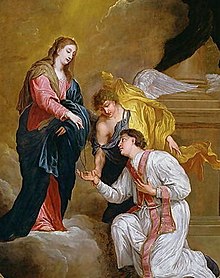
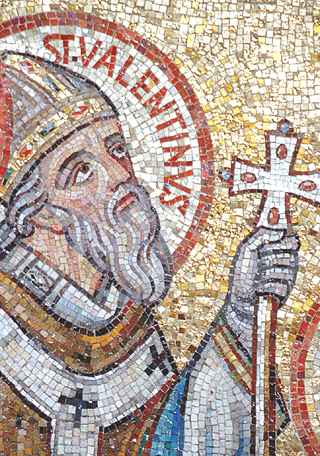
The truth about the life of St. Valentine is wrapped in mystery and shrouded by time. We have very few facts, but tradition holds that St. Valentine, or Valentius, was a Christian priest in the late third century. During the reign of Roman Emperor Claudius II, the Roman Army was in a state of decline. Claudius theorized that single men make better soldiers than married men. He therefore outlawed marriage for all young men. Valentius continued to perform marriage ceremonies in secret despite the emperor’s decree. Consequently, Valentius was imprisoned but met solace and comfort in the Lord and a friend he had made. The legend goes that Valentius fell in love with the jailer’s daughter, whose job it was to bring him his food. After the jailer reassigned his daughter, Valentius wrote her a love letter that became known as the first Valentine’s card. Eventually, Claudius executed Valentius on Feb. 14, but his legacy of love and devotion survived.


In 496, Pope Gesalius officially recognized Feb 14th as Valentine ’s Day of martyrdom and canonized him as a saint. During the middle ages, it became popular to celebrate Valentine ’s Day as a day of romance and marriage, even to exchange cards. The first surviving Valentine’s card we have dates from 1415. It was written by the Duke of Orleans when he wrote to his wife while he was in the tower of London after his capture at the battle of Agincourt. The tradition of celebrating with cards and gifts continued in America and this holiday remains one of the most popular on the calendar. So the next time you write a card or give a box of chocolates, you celebrate the legacy of love, marriage and the good St. Valentine.

Saturday, February 11, 2012

A Little Sea Trade


It has long been the prerogative of any seafaring nation to control the waters in which it trades. This prerogative stems from a simple ratio of 21:9:1. Before the invention of the locomotive, it took a traveler twenty-one days by foot, nine days by horse and one day by ship to reach his/her destination. Obviously, traveling by ship is the optimum choice. In ancient times, the seafaring nations of the Phoenicians and Greeks developed wealthy and more dynamic economies than those of the great land empires of Egypt and Babylon. During the Middle Ages, the Venetians and Genoese were the great shippers of spices and textiles. Indeed, the amount of capital that was tied into the shipping industry compelled the Venetians to form the first insurance companies, stock markets and of course, banks. These were the forces that kept the focus of European trade in the Mediterranean, but one man from Genoa was going to change all that.


In an effort to circle around the globe, thereby undercutting the Silk Road middlemen, Christopher Columbus set sail in 1492 in search of a passage to the spices of India and China. He didn’t find either, but what he did find, two new continents, gradually drew the focus of European trade away from the Mediterranean Sea and into the Atlantic. The seafaring nations of Europe established colonies and settlements in the new land in order to extract its vast natural resources. The Netherlands settled New Amsterdam, the Spanish settled Mexico and Peru, the French moved into Canada, the English established several colonies between French Canada and Spanish Florida, and all the powers had a smattering of sugar islands in the Caribbean. What followed was a series of naval wars in order to control not only the fledgling colonies in America, but the vast trade system that was growing around the globe. At first, the Spanish were dominant but that changed after the battle of the Armada in 1588. Next was the turn of the Dutch, but they eventually lost control to the English. But not even the great Atlantic could contain the ever-hungry, ever-growing arms of Europe and it soon looked beyond the western hemisphere and into the East.


At the dawn of the 19th century, Europe had stretched its reach all over the world, enveloping it in a new system of global trade and commerce. India was conquered and exploited by the British, the Dutch conquered Indonesia and parts of South Africa, while all the Europeans worked collectively to pry open China from the hands of the wary and jealous emperors there. By the end of the 19th century, the European countries had used up all possible outlets for empire and exploit in the Eastern Hemisphere. They would have tried to reclaim the lost colonies of Central and South America, but the young USA to the north wouldn’t let them. Without any more space to expand, the nations of Europe eventually turned on themselves and fought two world wars to determine who was on top of the global scene. The result was that none of them were dominant any longer. While the nations of Europe faded, new countries were able to develop their own trade systems with each other.  Although we now have electric trains, airplanes and automobiles, shipping by sea is still the most expedient means of transporting goods.  

Saturday, February 4, 2012

A Return to Russia Pt. 2

Poltava 1709

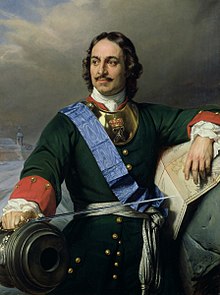
Czar Peter the Great looked over the remnants of the defeated Swedish army. Sweden and Russia had been at war for a long time and this was the climactic victory Peter had been waiting for. It all began with the accession of the young monarch.
Peter the Great

Peter Romanov had dedicated his career to changing his vast hermit kingdom into a modern European Empire. His first task was to move the capital from the ancient wooden city of Moscow. Instead of simply choosing a different city, Peter decided to build a new one. St. Petersburg was built to emulate and even rival the great capitals of Western Europe, such as London, Paris, Vienna, and Stockholm. Architects from France and Germany designed the city’s layout and buildings. French became the official language at the Russian court. Yet despite the advances, Russia had a long way to go. Peter knew that in order to advance Russia further, he needed to trade with Europe and in order to trade with Europe, Russia needed a fleet and merchant marine. The problem was Sweden.

Winter Palace Petersburg 

After Gustavus Adolphus invaded northern Europe during the Thirty Year’s War, Sweden had been a continental power. The subsequent Swedish monarchs turned the Baltic Sea into a Swedish Lake, keeping the Russians out. This state of affairs ultimately led to war, a war that ended with the battle of Poltava. Ten years after the battle, the Stockholm Treaties granted Russia large territories on the Baltic, opening up the rest of Europe to Russia’s vast untapped resources. Peter’s subsequent successor, Czarina Catherine the Great, conquered the Crimean Peninsula from the Ottoman Turks and opened up the Black Sea to Russian trade with the Mediterranean. Eventually, Russia became a lead player on the European stage and even expanded east. They didn’t stop expanding east until they reached the Pacific Ocean. Ultimately, the great empire that Peter and Catherine had created fell apart during the First World War and fomented into a communist revolution. But that’s a story for another day.