|
| Boniface VIII and Cardinals |
In the Middle Ages, the only institution that held more sway over the common people than the nobility did was the church. As it was the ordained arbiter between God and an ignorant flock, the church not only held spiritual power, but political, as well. Kings were crowned by bishops and emperors by popes. The church also wielded what was called the double-edged sword. In effect, this idea meant that the church was a check on secular power. Excommunication was the main force of the pope's temporal power. By excommunication, the pope denied the targeted sovereign the right to rule and encouraged other kings to seize his lands. Not only were the pope and his clergy powerful, but they were also rich. Its members constituted 2% of the population, but they controlled 30% of the land and wealth. Inevitably, this led to abuse and the pursuit of clerical office merely for money. As though this were not bad enough for the lay people, worse was yet to come.
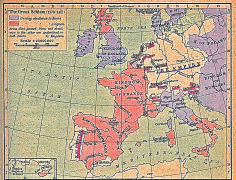 |
| Political split between the two Papal factions |
In 1378 two rival popes claimed the Papacy, dividing the Catholic Church in two. Both simultaneously excommunicated each other and their respective flocks. This meant that everyone in medieval Europe at this time was under excommunication from one pope or the other. While the two factions fought it out for 39 years, the common people were left to doubt and worry. They were uncertain that their child could really be baptized by an excommunicated clergy, or that last rites and burial would save them from eternal damnation. In this way the church lost the faith of the French people. Although the schism was healed in 1417 and the church was able to regain some sense of legitimacy, deep currents of discontent were brewing that would come to a head in the late 18th century.